Listen to this article
Listen time 5 min 50 s
Show the transcript
The old fence is leaning, rotting or half down, and you want it replaced with your neighbour sharing the cost. The Dividing Fences Act 1991 (NSW) sets out how that works: who pays, what you have to put in writing, how long you wait, and who decides if you cannot agree.
This guide takes the Act's steps in order and adds the step to take before the notice: settling the line the fence will be built on.
General information only, not legal advice. Government pages checked 10 November 2026. Act text taken from the official NSW legislation pages as archived in January 2026 (Dividing Fences Act 1991, in force since 1 July 2018) and October 2025 (Surveying and Spatial Information Act 2002).
The Dividing Fences Act in NSW, in short
Where there is no sufficient fence between two properties now, the neighbours pay equal shares for a "sufficient dividing fence". If one of you wants something better than that, the extra cost is theirs (Dividing Fences Act 1991, s 6 and s 7).
If you cannot agree, the process is a written fencing notice, a one-month wait, and then an application to the NSW Civil and Administrative Tribunal (NCAT) or the Local Court for a fencing order (s 11 and s 12; NCAT, dividing fences).
Key takeaways
- A fencing notice must say which line the fence will be built on, the type of work and the estimated cost.
- Your neighbour does not have to contribute to work done before the notice is served (except in limited cases such as urgent work), or after it but before you agree or an order is made.
- If there is no agreement one month after the notice, either owner can apply to NCAT or the Local Court.
- If you are unsure where the boundary is, settle the line before you serve the notice. If you and your neighbour disagree on it, the Act has a procedure for having it defined by a registered surveyor.
What a "sufficient dividing fence" is, and who pays for more
The Act does not set one standard. If it comes to a decision, NCAT or the Local Court looks at all the circumstances, including the existing fence, how the land is used, privacy, the kind of fence usual in the area and any council fencing policy (s 4).
In practice the usual cost situations are:
| Situation | Who pays | Where the Act says it |
|---|---|---|
| There is no sufficient fence now, and the new one is built to a sufficient standard | Both owners, in equal shares | s 6, s 7(1) |
| One owner wants a higher, longer-lasting or more expensive fence | That owner pays the amount above the sufficient standard | s 7(2) |
| The notice proposes a different split | Only if the neighbour agrees, or a court or NCAT orders it | s 11(3), s 14 |
| One owner's negligent or deliberate act damaged the fence | That owner can be liable for up to the whole cost of restoring it | s 8 |
Two related rules sit outside the cost question:
- Height and approval. On residential land, side and rear boundary fences can be built without planning approval (exempt development) up to 1.8 metres high, or 1.2 metres if masonry, when the other conditions are met. The NSW Planning Portal notes that if the fence separates neighbouring lots, the Dividing Fences Act also applies (NSW Planning Portal, fences).
- Retaining walls. A "fence" under the Act includes any foundation or support the fence needs, but not a retaining wall as such, and the Act does not change the law on retaining walls or support between neighbouring land (s 3 and s 26). On a sloping Illawarra block where the fence sits on a wall, get engineering or legal advice on the wall separately. If the wall or structures sit near the line, a detail survey records where they are.
The steps in order, from first conversation to orders
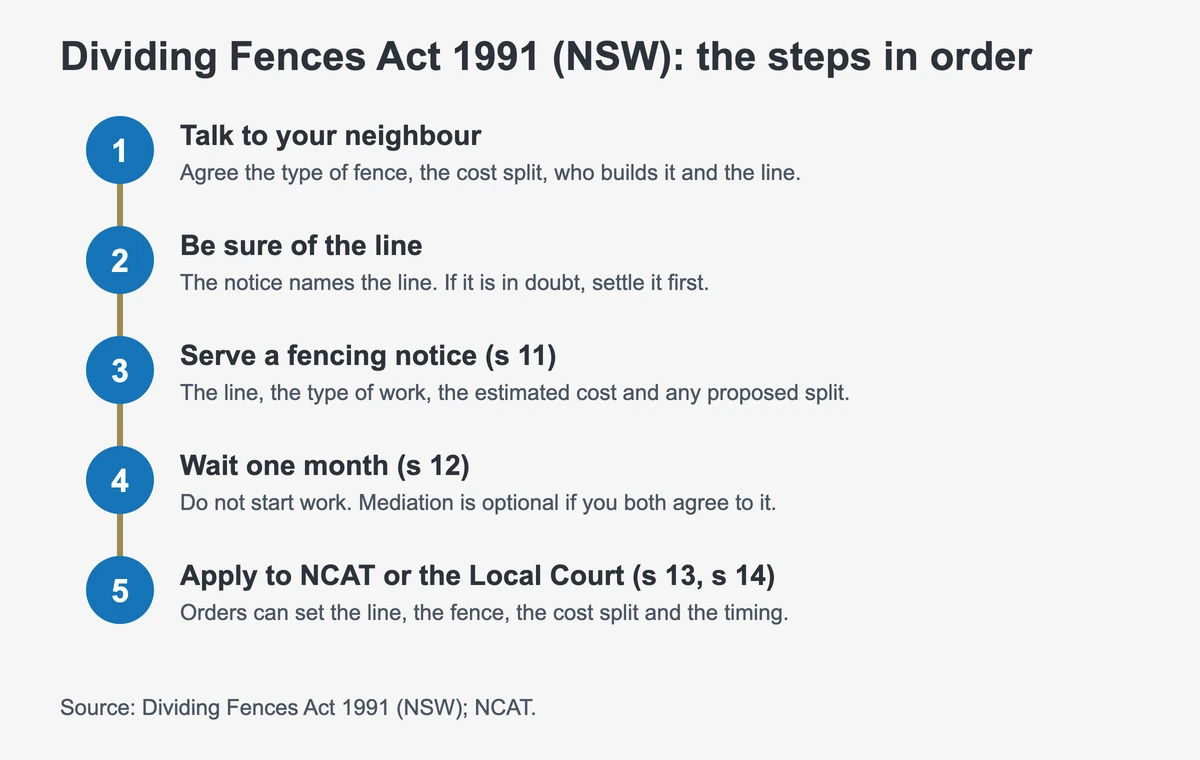
1. Talk to your neighbour. Start with a conversation. Agree the type of fence, the cost split, who will build it and the line. Put the agreement in writing.
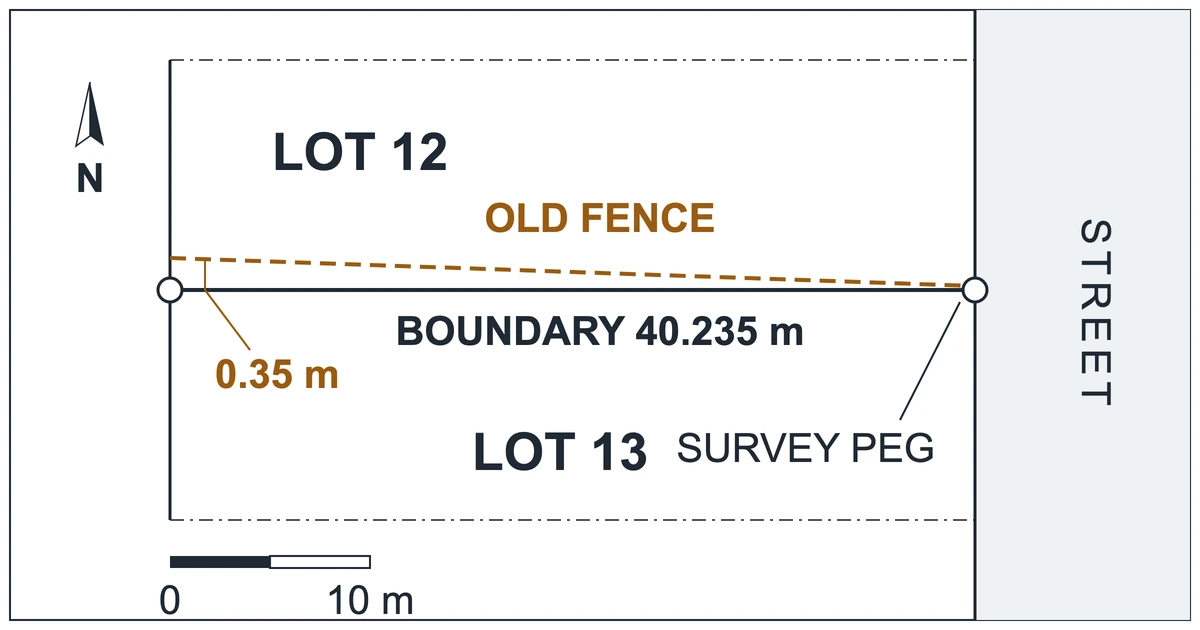
2. Be sure of the line. The notice has to name the line the fence will be built on. If you both agree the old fence is on the boundary, note that; if not, settle it before anyone quotes (see the next two sections).
3. Serve a fencing notice. If you cannot agree, or want the agreement on the record, serve a written fencing notice under section 11. It must state (s 11(2) and (3)):
- The line. The boundary line the fence will be built on or, if building on the common boundary is impracticable, the line you propose.
- The work. The type of fencing work, for example length, height and materials.
- The cost. The estimated cost of the work.
- The split. If you propose anything other than equal shares, the proportions.
Legal Aid NSW says there is no set form, suggests attaching a written quote and stating who will do the work and the start and finish dates, and explains that the notice can be handed over in person or posted to the owner's address. Keep a copy and note the date (Legal Aid NSW, preparing a fencing notice).
Do not start work early. Unless the work was urgent (s 9) or NCAT or the court gave leave to serve the notice late (s 22), your neighbour does not have to contribute to fencing work done before the notice is served. They also do not have to contribute to work done after it but before you agree or the matter is decided (s 11(5)).
4. Wait one month. If you have not agreed within one month after the notice was served, either owner can apply for orders (s 12(2)). NCAT requires the notice to have been served at least one month before you apply, and it must be attached to the application (NCAT).
A note on mediation. The Act still says neighbours may go to a Community Justice Centre. Since 1 July 2025, Community Justice Centres no longer offer mediation except for disputes referred by NSW courts or involving incorporated associations (Community Justice Centres). You can still suggest mediation to your neighbour before applying, as Legal Aid NSW does.
5. Apply to NCAT or the Local Court. Either can decide any matter under the Act (s 13). Orders can cover the line the fence is built on, the kind of fence, how costs are shared, which part each owner builds, when the work is done, and even that no fence is needed (s 14(1)).
Where does the new fence go?
Usually on the common boundary, the legal line between the two titles. But the Act does not assume the fence is there. It defines a dividing fence as one separating the two properties "whether on the common boundary" or on another line (s 3), and NCAT or the Local Court can order the line the fence is built on, "whether or not" it is the common boundary (s 14(1)(a)).
That matters because the old fence is not a reliable guide. It may have been built by eye decades ago, moved during a rebuild or set back on a slope. The boundary lines on NSW government maps are not a measurement either: Spatial Services explains that the state's map of land parcels was traced by hand and digitised without survey control, and that it has since improved the positions of more than 1.3 million parcels (Spatial Services, history of the NSW Spatial Cadastre).
Do I need a survey to build a fence in NSW?
Usually only when the line is in doubt. If you and your neighbour are both confident the existing fence is on the boundary and you agree to replace it like for like in the same position, you may not need one.
A survey earns its place when:
- the old fence is gone, bent, or looks off line along its length;
- the block slopes and the fence sits on or near a retaining wall;
- you are building something more permanent, such as masonry, or a structure near the line;
- your neighbour questions where the boundary is, or the notice will go to NCAT.
Four points from the Act and NCAT's guidance are worth knowing:
- Surveying can be part of the shared cost. The Act's "fencing work" includes surveying land along the common boundary for the fence (s 3), so it can be included in the work and the estimated cost in your notice.
- If you disagree on the line, the Act has a procedure. You can give your neighbour written notice that you intend to have the common boundary defined by a registered surveyor. Your neighbour then has 7 days to peg the line themselves or engage a registered surveyor, and must tell you in writing what they did. If they only peg it, or do not have it surveyed within a month, you can have a registered surveyor define it. If your surveyor finds the line where your neighbour's pegs put it, you pay your neighbour's costs. Otherwise reasonable survey costs are shared equally (s 18).
- NCAT lists it as evidence. NCAT includes a "current survey of boundary line (if available)" in the evidence to gather for a fencing application, with the notice, photos and receipts (NCAT).
- A paid boundary survey is done by a registered land surveyor. In NSW, identifying or marking out the boundaries of land for a fee is a land survey that must be carried out by a registered land surveyor (Surveying and Spatial Information Act 2002, s 3 and s 21).
Before you book, you can look at the records yourself. The NSW Planning Portal Spatial Viewer lets you search your address or lot and deposited plan (DP) number and see your property mapped (NSW Planning Portal Spatial Viewer guidance); as above, the mapped line is not a measurement. NSW Land Registry Services explains that title records are available online, in person or through an authorised information broker (NSW LRS, record searches). A title search identifies your lot and deposited plan, the registered plan that defines your land's boundaries on paper (NSW LRS, plans). None of these puts a mark on the ground.
A boundary survey checks the title and earlier survey evidence, marks the boundary positions on site and checks the existing fence and nearby structures against them. You, your neighbour and the fencer then work from the same marks.
Replacing a dividing fence in Wollongong or the Illawarra?
Tell us the address and what is happening with the fence. We will tell you whether the line needs checking and give you a free, no-obligation quote.
What to send for a quote, and what you hand the fencer and your neighbour
To quote a boundary survey for a fence, we need:
- the property address (and the lot and deposited plan number if you have a title search);
- which boundary or boundaries the fence runs along, and roughly how long;
- what is there now: the old fence, a retaining wall, a slope, structures near the line;
- your timing, such as a fencer's start date or a fencing notice you are about to serve.
Once the boundary is marked, give the fencer the marks to build to, share the survey with your neighbour and keep a copy with your fencing notice. If the matter goes to NCAT, it is ready to attach.
We work across Wollongong and the Illawarra, with over 10 years' experience. Call (02) 4210 5831 or use the contact form.
Frequently asked questions
Who pays for a dividing fence in NSW?
Where there is no sufficient fence now, both neighbours pay equal shares for a fence of a sufficient standard. An owner who wants a better fence pays the extra (Dividing Fences Act 1991, s 6 and s 7).
What has to be in a fencing notice?
The line the fence will be built on, the type of fencing work and its estimated cost, plus any proposed split other than equal shares (s 11). Legal Aid NSW publishes a step-by-step guide and sample notices.
What happens if my neighbour does not respond?
Does the Dividing Fences Act cover retaining walls?
Only so far as a wall is the foundation or support the fence needs. A retaining wall as such is not a "fence" under the Act, and the Act does not change the law on retaining walls (s 3 and s 26).
Do I need a survey before replacing a fence?
Not always. If the line is in doubt, the fence is on a slope or wall, or the matter may go to NCAT, having the boundary marked gives you and your neighbour the same line to build on, and surveying for the fence can form part of the fencing work (s 3).
Know the line before you serve the notice
Free, no-obligation quotes for boundary surveys across Wollongong and the Illawarra.