
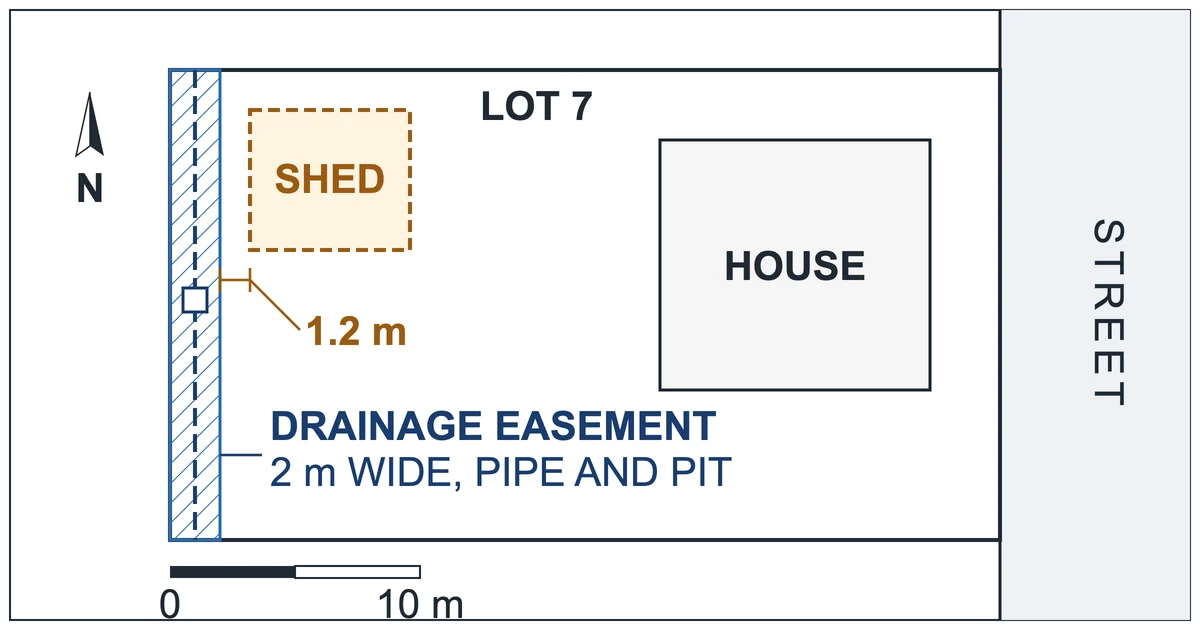
An easement in NSW is a registered right that lets someone other than the owner use part of your land for a set purpose, most often drainage, sewer, water, electricity or access. You still own the strip, but what you can build on it, and sometimes beside it, depends on the easement's terms and on the authority that relies on it.
In Wollongong and the Illawarra, most easements on house blocks are held by one of three bodies: Wollongong City Council for stormwater, Sydney Water for water and sewer, and Endeavour Energy for electricity. Before you pour a slab, order a shed or design an extension, check the record, ask the right body, and know where the strip sits on the ground.
General information only, not legal advice. Council, Sydney Water, Endeavour Energy and NSW Land Registry Services pages checked 19 November 2026.
Key takeaways
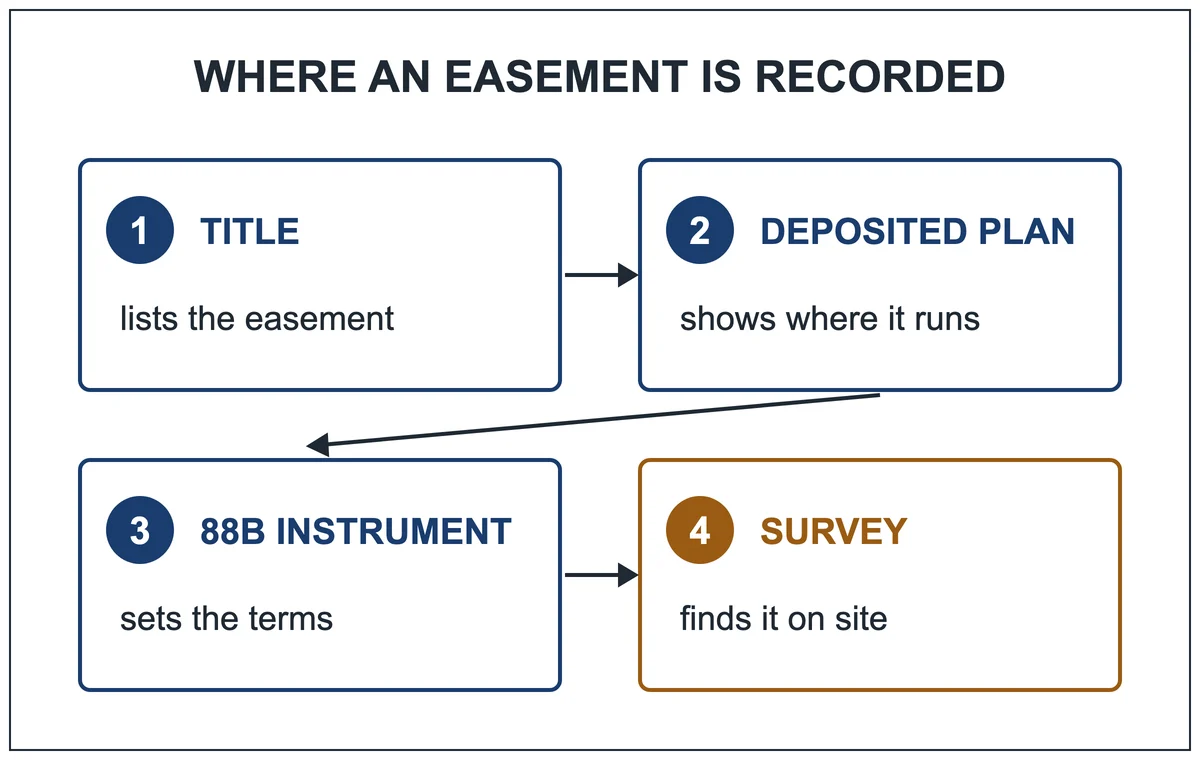
- Your title shows whether an easement affects your land. The deposited plan shows where the strip is, and the section 88B instrument or other registered document sets its terms.
- Wollongong City Council says major construction is usually not allowed on land within an easement, and light, open structures may be considered case by case.
- A garden shed only counts as exempt development (no approval needed) if it sits at least 1 m from any registered easement and meets the other exempt development rules.
- Sydney Water needs to approve building work near its pipes before you start, including sheds, decks, fences, pools and landscaping.
- Endeavour Energy prohibits houses, garages, pools and tall trees in its easements, and asks you to contact it before you seek council consent.
- Locate the easement on site before you design, so the plans are drawn from measured positions rather than a guess.
What an easement on your property means
Wollongong City Council describes an easement as "a nominated section of public or private land that is used by someone other than the landowner" to reach drainage, sewer, water, gas, electricity or similar services (Wollongong City Council, easements). A shared driveway is another common example (Council, stormwater maintenance).
Three points follow from that:
- You keep ownership. Endeavour Energy says an easement lets it install and maintain equipment "without removing the ownership of that land" from the owner (Endeavour Energy, poles, wires and easements).
- The holder needs access. Pipes, pits and cables in an easement have to be reached for repairs and maintenance, which is why building over them is restricted.
- Each easement has its own terms. Two drainage easements on neighbouring lots can say different things, so the registered terms for your lot are what count.
How to check easements on a property in NSW
Three records work together.
- The title certificate. Council notes that your land title certificate "will show whether an easement that benefits Council is on their land", and that title records can be searched online or in person through NSW Land Registry Services (Council; NSW LRS, record searches). Authorised information brokers can also supply them.
- The deposited plan. The plan shows where the easement runs on your lot.
- The section 88B instrument, or another registered document. Many easements are created by a deposited plan lodged with an instrument under section 88B of the Conveyancing Act 1919 (NSW LRS, section 88B instruments). Others are created by a transfer granting the easement. Either way, the easement is recorded on the title of the land it affects (Willoughby City Council, creating an easement). The 88B instrument sets out, or refers to, the terms: what the easement is for, and what the owner may and may not do.
Two gaps are worth knowing. Council says its stormwater assets "could be located within private land without an easement in place", and it will check its asset register if you ask (Council). Endeavour Energy notes that section 53 of the Electricity Supply Act 1995 covers its rights for electricity works built before 2006 without an easement (Endeavour Energy). If there is a pit, pole or cable on your block and nothing on the title, ask.
Common easements on Wollongong properties
| Easement | Who usually relies on it | What they say about building | First contact |
|---|---|---|---|
| Stormwater drainage | Wollongong City Council, or a neighbouring lot | Major construction usually not allowed on the easement; very light, open, relocatable structures such as open carports may be considered case by case; building next to a drainage easement is allowed if it meets the Wollongong DCP stormwater chapter | Council, (02) 4227 7111 |
| Water and sewer | Sydney Water | Approval needed before building or excavating near its pipes, including sheds, decks, fences, pools, driveways and landscaping; no building over pressure mains, sewer mains 750 mm or wider, or other critical assets | Sydney Water Tap in |
| Electricity | Endeavour Energy | Houses, granny flats, garages, pools and spas, retaining walls and trees over 3 m are prohibited in its easements; ask before any activity in or near one | Endeavour Energy, 131 003 |
| Private access (right of carriageway) or drainage | A neighbour's lot | Set by the registered terms between the lots | Your solicitor or conveyancer |
Sources for the table: Council, easements; Sydney Water, building plan approval and its building over or adjacent to assets policy; Endeavour Energy. Sydney Water's area covers the Illawarra (Sydney Water, avoid damaging our pipes), and Endeavour Energy's network includes Wollongong, Shellharbour and Kiama (Endeavour Energy, what we do).
Can I build over an easement? Sheds, slabs, pools, fences and trees
It depends on who holds the easement and what its terms say. Here is what each authority's own pages say about the questions owners ask most.
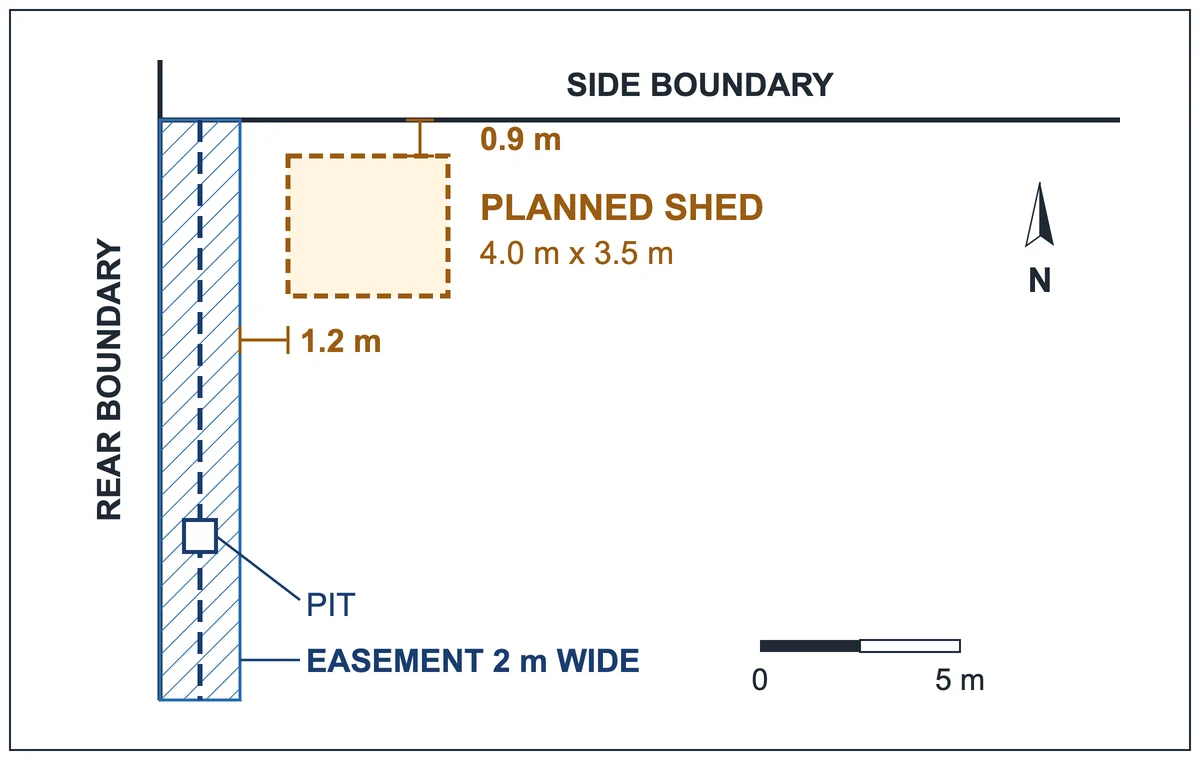
A shed or carport. A garden shed is exempt development (no approval needed) only if it meets the state rules, which Council links from its sheds page. Those rules include a floor area of no more than 20 m² on most residential land and a position at least 1 m from any registered easement (State Environmental Planning Policy (Exempt and Complying Development Codes) 2008, cl 2.18). Closer than that, or on the easement, the shed is no longer exempt, so check the approval it needs with Council or your certifier before you build.
On the easement itself, Council may consider "very light and relocatable buildings like open carports or other open structures" on easements, case by case and often with strict conditions (Council). Endeavour Energy lists garages and shipping containers among the prohibited structures in its easements (Endeavour Energy). Sydney Water lists sheds among the projects that need its approval when they are near its pipes (Sydney Water).
A slab, driveway or paving. Sydney Water's approval covers driveways, landscaping, retaining walls and "excavation, demolition or ground changes" near its assets. In an Endeavour Energy easement, excavating or filling over an underground cable is prohibited (Endeavour Energy).
A pool or spa. Endeavour Energy prohibits inground and aboveground pools and spas in its easements (Endeavour Energy). Sydney Water lists pools among the works that need its approval (Sydney Water).
A fence. Sydney Water's list includes fences. If the easement runs along a side or rear boundary and the fence is being replaced with your neighbour, the Dividing Fences Act guide covers the shared cost and notice steps.
Trees and gardens. In Endeavour Energy easements, trees or shrubs that will grow over 3 metres, or with roots deeper than 400 mm, are prohibited (Endeavour Energy). For other easements, check the terms and ask the authority before planting anything with deep roots over a pipe.
Building beside the strip, not on it. Council allows building next to a drainage easement where the work meets the Wollongong Development Control Plan's stormwater chapter (Chapter E14) (Council). Sydney Water also assesses building "adjacent" to its assets, not only over them, so a footing close to a sewer line can still need its approval.
Sydney Water warns that if you start work without its approval and damage its assets, you may face fines and repair costs (Sydney Water).
Who maintains the pipe in the easement?
If the title shows a drainage easement benefiting Council, Council says any stormwater infrastructure in it is likely a Council asset; if a structure turns out to be private, the owner maintains it (Council). Council's short video explains owners' stormwater responsibilities.
In an electricity easement, owners must allow Endeavour Energy access to its equipment, which can mean a utility lock on a gate and keeping the area around the equipment clear (Endeavour Energy).
Who to ask first, and what to have ready
Contact the body that relies on the easement before you lodge plans. Endeavour Energy asks to hear from you before the activity and "before seeking development consent from your local council" (Endeavour Energy).
- Your records: the title search, the deposited plan and the 88B instrument (or the transfer that created the easement).
- A site plan: where the shed, slab, pool or extension will go, with its distance from the easement and the boundaries.
- Stormwater: Wollongong City Council's duty planner, or Customer Service on (02) 4227 7111 for whether a pipe is on Council's asset register.
- Water and sewer: Sydney Water Tap in. Free asset plans come from Before You Dig Australia, and a service location diagram can be bought through Tap in.
- Electricity: Endeavour Energy on 131 003.
- The terms themselves: a solicitor or conveyancer if you need to know what the instrument allows or whether it can be varied.
Finding the easement on the ground before you design
The plan tells you how wide the strip is and where it runs relative to your boundaries. It does not put anything on the ground. Old fences are not always on the boundary, pits can be buried under gardens, and online maps are not measurements. Sydney Water's own advice is to locate all underground services during design and to dig by hand near them until they are found (Sydney Water, avoid damaging our pipes).
That is where a survey helps. In NSW, identifying or marking out the boundaries of land for a fee is a land survey that must be carried out by, or under the supervision of, a registered land surveyor (Surveying and Spatial Information Act 2002, s 3 and s 21). Two of our services are relevant:
- A boundary survey marks the boundary positions on site and checks fences and nearby structures against them. Easements are defined against those boundaries.
- A detail survey records the site's features, including buildings, fences, trees and services, in a plan your designer can draw on, supplied as a PDF and an AutoCAD DWG file.
With measured positions, your designer, certifier and the authority are all looking at the same distance between the structure and the strip.
Planning a shed, pool or extension near an easement in Wollongong or the Illawarra?
Send us the address and what you want to build. We will give you a free, no-obligation quote.
What to send for a quote
To quote quickly, we need:
- the property address, and the lot and deposited plan number if you have a title search;
- what the easement is for, if you know (drainage, sewer, electricity or access) and where it runs;
- what you plan to build and roughly where;
- whether your designer or certifier has asked for a particular plan, and your timing.
We work across Wollongong and the Illawarra, with over 10 years' experience. Call (02) 4210 5831 or use the contact form.
Frequently asked questions
What is an easement in NSW?
A registered right for someone other than the owner to use part of a property for a set purpose, such as drainage, sewer, water, electricity or access. The owner keeps ownership, but the easement's terms limit what can be done on the strip (Wollongong City Council).
How do I check easements on a property in NSW?
Start with a title search from NSW Land Registry Services, online, in person or through an information broker. The title shows the easement, the deposited plan shows where it runs, and the 88B instrument or transfer sets its terms (NSW LRS).
Can I build a shed over an easement?
Sometimes, if it is light and open. On the easement itself, Wollongong City Council may consider light, open, relocatable structures case by case, Endeavour Energy prohibits garages and shipping containers in its easements, and Sydney Water must approve sheds near its pipes. Beside it, a garden shed is exempt development (no approval needed) only if it is at least 1 m from any registered easement and meets the other exempt development rules (Council, easements; Sydney Water; Council, sheds).
Who is responsible for easement maintenance in NSW?
It depends on who owns the infrastructure. Council says stormwater infrastructure in a drainage easement benefiting Council is likely a Council asset, while private drainage is the owner's to maintain. In electricity easements, owners must keep access to Endeavour Energy's equipment clear (Council; Endeavour Energy).
What is a section 88B instrument?
A document registered with a deposited plan under section 88B of the Conveyancing Act 1919. It creates and sets the terms of easements, restrictions on the use of land and positive covenants on the lots in that plan (NSW Land Registry Services).
Get a free quote for your block
Building near an easement in Wollongong?
Free, no-obligation quotes for boundary and detail surveys across Wollongong and the Illawarra.